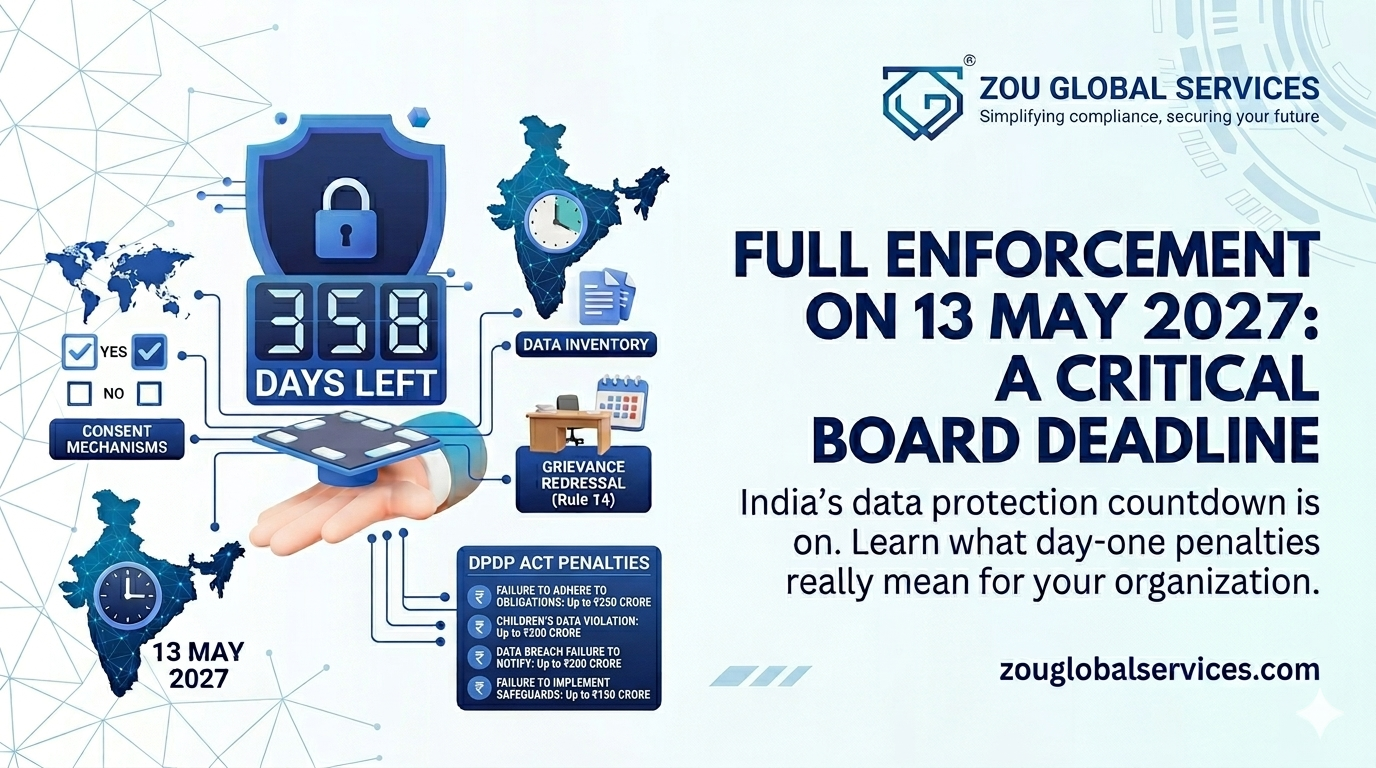
India's most significant data protection law is no longer a regulatory proposal. The Digital Personal Data Protection Act, 2023 (DPDPA) is live, its Rules have been notified, the Data Protection Board of India (DPBI) is operational, and its members are being appointed, and the 18-month countdown to full enforcement is already underway. The deadline is 13 May 2027. That is approximately twelve months from today.
Boards across India are asking: 'How serious is this, really? And what do we actually need to do?' This article answers both questions directly, with evidence, and without the legal jargon.
Why 13 May 2027 Is Not Just Another Regulatory Deadline
Most compliance deadlines in India have historically come with informal grace periods the kind where enforcement eases in slowly, and companies that are 'trying' are largely left alone. DPDPA is different, and here is why your board needs to understand the distinction.
The DPDP Rules were notified on 13 November 2025. That date triggered a precise, legally defined 18-month implementation window. Three milestones define what that window looks like:
| Milestone | Date | What It Means |
| DPDP Rules Notified | 13 November 2025 | 18-month compliance clock starts. Board operational. |
| Consent Manager Framework Live | 13 November 2026 | Organisations must integrate with Consent Manager APIs. |
| Full Enforcement | 13 May 2027 | All obligations binding. No grace period. Penalties apply from Day 1. |
The critical detail is in that final row: May 2027 is a hard cutoff. Legal experts and compliance practitioners widely expect the DPBI to move immediately into enforcement mode, no transitional leniency, and no soft-start period for latecomers. As SecurePrivacy's analysis notes, 'post-May 13, 2027 enforcement is immediate; no grace period; penalties apply from Day 1.'
The government has signalled this seriousness in other ways too. Shortly after the Rules were notified, Minister of Electronics and Information Technology Ashwini Vaishnaw indicated that the government was exploring whether the 18-month window could be shortened to 12 months. That proposal did not proceed, but the intent behind it speaks volumes about the regulatory posture India is adopting.
| The 2026 'build year' framing used widely in compliance circles is accurate. But it also implies that any organisation that hasn't started building in 2026 will run out of road well before May 2027. Architecture redesigns, vendor contract overhauls, consent infrastructure, and grievance mechanisms all require months of implementation and testing not weeks. |
The Penalty Structure Your Board Must Understand
The DPDPA's penalty regime is fundamentally different from what Indian businesses have dealt with before and not in a way that allows for comfortable optimism.
Under the old IT Act framework, penalties for data protection failures were often modest, revenue-based, and difficult to enforce. DPDPA replaces this with absolute, fixed monetary penalties that apply regardless of company size, sector, or revenue:
| Violation | Maximum Penalty |
| Failure to implement reasonable security safeguards | ₹250 Crore (~$30 million USD) |
| Failure to notify Data Protection Board / affected individuals of a breach | ₹200 Crore (~$25 million USD) |
| Violations related to children's data | ₹200 Crore (~$25 million USD) |
| Failure to handle grievance redressal | ₹50 Crore (~$6 million USD) |
| Other violations by a Data Fiduciary | ₹50 Crore (~$6 million USD) |
Three implications your board must internalise:
- These are per-instance penalties, not annual caps. Multiple violations from a single breach event can compound.
- Absolute amounts mean equal exposure for a 50-person fintech and a 5,000-person bank. ₹250 crore is ₹250 crore, regardless of your revenue.
- Grievance redressal failures are often the most overlooked. Rule 14 mandates a published, accessible grievance mechanism with a hard 90-day resolution SLA. Failure to resolve a complaint within 90 days escalates directly to the DPBI and a ₹50 crore fine.
India's cybercrime losses are already projected to reach ₹20,000 crore across sectors in 2025, with banking and financial services bearing ₹8,200 crore of that burden. The DPDPA's penalty structure is designed to ensure that data protection failures are no longer economically rational choices.
India Has Already Seen What Happens Without Legal Teeth And It Wasn't Pretty
To understand where India is going, it is worth looking clearly at where it has been. Under the old IT Act and SPDI Rules, Indian companies that suffered data breaches faced almost no regulatory consequences. Not because the breaches were small but because the law lacked the enforcement mechanisms to hold anyone accountable.
The record speaks for itself.
Case 1: BigBasket 20 Million Customers, Zero Accountability (2020)
In October 2020, BigBasket, India's largest online grocery platform, suffered a data breach that exposed the personal information of approximately 20 million customers. The stolen data included email addresses, password hashes, phone numbers, physical addresses, birthdates, and detailed purchase histories. It surfaced on dark web marketplaces, available for purchase by anyone willing to pay.
The incident was reported by an international cybersecurity firm, Cyble. BigBasket acknowledged the breach only after being approached by media, not proactively, not to its users, and not to any regulator. Under the DPDPA's framework, this delayed and passive response to a breach of this scale would attract a penalty of up to ₹200 crore for failure to notify the Data Protection Board.
| Under DPDPA, the 72-hour notification clock starts from the moment of breach discovery not from when a media outlet calls you. |
Case 2: MobiKwik 100 Million Users, Denied Until the Dark Web Proved Otherwise (2021)
In early 2021, security researchers uncovered what French cybersecurity expert Elliot Alderson described as 'likely the biggest KYC data leak in history. MobiKwik, one of India's largest digital payments platforms with over 101 million registered users at the time, allegedly had its data compromised exposing KYC documents, credit card details, addresses, and transaction histories of millions of users.
The company's response was not to investigate and notify. It was to deny publicly, forcefully, and repeatedly. MobiKwik labelled the security researchers 'media-crazed' and dismissed the evidence. This despite users independently finding their own information in the leaked dataset. The Reserve Bank of India eventually stepped in and ordered a forensic audit. No penalty followed because, again, no law existed with the teeth to impose one.
Under DPDPA Section 8(6), a Data Fiduciary must notify the Board 'without delay' upon becoming aware of a breach. Under DPDPA, denial is not a compliance strategy “it is an aggravating factor that regulators use to justify higher penalties”.
| The absence of a law didn't mean the harm didn't happen. It meant the company didn't pay for it. DPDPA ends that arrangement. |
Case 3: Air India 4.5 Million Passengers, a Vendor's Failure, and a Lesson in Third-Party Risk (2021)
In February 2021, SITA, the global air transport data company that processed Air India's passenger service systems suffered a sophisticated cyberattack. The breach compromised the personal data of approximately 4.5 million Air India passengers worldwide, including names, dates of birth, contact information, passport details, ticket information, and credit card data covering records from August 2011 to February 2021.
Air India received the first notification from SITA in February 2021. It did not disclose to passengers until May 2021 a gap of nearly three months. The data covered nearly a decade of passenger records, pointing to systemic failures in data minimisation and vendor oversight that had gone uncorrected for years.
DPDPA introduces direct Data Fiduciary obligations for how Data Processors, third parties like SITA are contracted, overseen, and held accountable. A breach in a vendor's system is not a shield from liability under DPDPA. It is, in fact, a separate obligation: Data Fiduciaries must ensure their processors comply, and must notify the Board within 72 hours regardless of where in the vendor chain the breach occurred.
| The DPDPA does not accept 'our vendor was breached' as an answer. It accepts evidence that your vendor agreements, oversight mechanisms, and incident response procedures were robust enough to meet your obligations. |
What GDPR Taught the World And What India Is Choosing to Learn From It
India is not building its enforcement framework in a vacuum. The DPDPA's architects studied the General Data Protection Regulation (GDPR) that came into force in Europe in May 2018 and they made deliberate choices about what to adopt and what to make harder.
The GDPR Trajectory: Slow Start, Steep Acceleration
When GDPR went live in 2018, many companies assumed the enforcement would be gradual and lenient. In the first year, they were partially right only 16 fines were issued across the EU, totaling approximately €55 million, with a single €50 million fine against Google by France's CNIL accounting for almost 90% of that amount.
But that was year one. The pattern since then has been unambiguous acceleration:
- 2018: 16 fines issued across the EU
- 2020: ~302 fines issued
- 2021: ~266 fines issued, plus the €746 million Amazon fine, the largest in GDPR history at the time
- 2023: Meta fined €1.2 billion for unlawful data transfers, the single largest GDPR fine ever issued
- 2018–2025 cumulative: Over €5.88 billion in fines across sectors
The lesson is not that GDPR started gently. The lesson is that regulators used the early period to build capacity, establish precedent, and identify the highest-profile targets and then accelerated enforcement sharply. British Airways was fined for inadequate security controls. Marriott International faced a massive penalty for a breach that exposed data of 339 million guests across 31 EEA countries. Google was fined not for a breach, but for consent mechanisms that were insufficiently transparent.
What India Chose to Do Differently
India's DPDPA reflects the GDPR's framework in its architecture consent, data subject rights, breach notification but deliberately made the penalties regime more unforgiving in one critical way: penalties under DPDPA are absolute fixed amounts, not percentages of revenue.
Under GDPR, a large company's fine is capped at 4% of global annual turnover. A company with €10 billion in revenue faces a maximum GDPR fine of €400 million. Under DPDPA, every Data Fiduciary a five-person startup or a five-thousand-crore bank faces the same ₹250 crore maximum. This eliminates the calculation some global companies have made under GDPR: that the cost of compliance exceeds the expected value of the fine.
| DPDPA's penalty structure was specifically designed so that non-compliance is never the economically rational choice. ₹250 crore is ₹250 crore for everyone. |
The Five Board-Level Questions That Must Be Answered Before May 2027
If your board has not yet had a structured conversation about DPDPA, the questions below are where to start. These are not legal questions they are governance questions. The legal team answers them; the board owns them.
1. Are we a Data Fiduciary, and have we mapped every category of personal data we collect?
DPDPA applies to every organisation that determines the purpose and means of processing personal data of Indian citizens in India or from outside India. If your product, service, HR system, or marketing stack touches the personal data of Indian residents, you are likely a Data Fiduciary. The starting point for all compliance is an accurate data inventory: what personal data you hold, where it lives, who has access, for what purpose, and how long you retain it.
2. Do we have a valid, documented consent mechanism or a cookie banner?
DPDPA defines consent very specifically. It must be free, specific, informed, unconditional, and unambiguous. Pre-ticked boxes are not consent. Bundled consent (agreeing to data collection for analytics bundled with agreeing to service delivery) is not consent. Each processing purpose requires a separate, explicit opt-in. And withdrawal must be as easy as giving consent, a single action that cascades across your entire data stack. A cookie banner is not compliance. Neither is a checkbox buried in your terms and conditions.
3. Can we respond to a Data Subject Access Request in 90 days for every user, across every system?
Every Indian citizen now has the right to access their data, correct it, erase it, and withdraw consent. Your organisation must be able to respond to these requests within 90 days. At any meaningful scale, this is operationally impossible to handle manually. You need automated data assembly that pulls from every system where personal data lives: CRM, databases, vendor tools, analytics platforms, HR systems and delivers a complete, accurate response without a team manually chasing data across a dozen applications.
4. Is our Grievance Redressal Mechanism published, accessible, and actually functional?
Rule 14 of the DPDPA mandates every Data Fiduciary to maintain a published, accessible grievance redressal mechanism with a hard 90-day resolution SLA. This is not a help desk email address. It requires a structured intake system, classification and routing workflows, SLA tracking with escalation triggers, and a complete audit trail of every grievance from intake to resolution. Failure to resolve a grievance within 90 days allows the data principal to escalate directly to the DPBI triggering an inquiry and a potential ₹50 crore fine.
5. What does our security architecture actually look like and can we prove it to a regulator?
DPDPA Section 8(5) requires Data Fiduciaries to implement 'reasonable security safeguards to prevent personal data breach.' The maximum penalty for failure is ₹250 crore. 'Reasonable' is not defined which means the burden falls on you to demonstrate that your measures were appropriate to the sensitivity and volume of data you process. Encryption at rest and in transit, access controls, incident response plans with documented 72-hour notification procedures, and immutable audit logs are the baseline expectation. If a breach occurs and you cannot demonstrate robust, proactive security measures, the Board has every reason to apply the maximum penalty.
2026 Is the Build Year. It Is Already May.
The compliance community refers to 2026 as the 'build year' the period during which organisations move from policy to implementation. That framing is accurate. But it should not breed comfort in boards that are still at the policy stage.
Consider the realistic implementation timeline for an organisation starting today:
- Weeks 1–4: Data audit and inventory across all systems and vendors
- Weeks 4–8: Gap assessment against all DPDPA obligations
- Weeks 8–16: Consent framework design and implementation
- Weeks 12–20: DSAR portal build and testing
- Weeks 16–24: Grievance redressal system setup
- Weeks 20–28: Security architecture review and hardening
- Weeks 28–36: Training, testing, and documentation
- Weeks 36–52: Audit readiness, external validation, and monitoring
That is a 9–12 month timeline for an organisation that is well-resourced, focused, and making no mistakes. For organisations that are starting from a fragmented data landscape or outdated vendor contracts, add another 3–6 months.
| There are approximately 12 months between now and 13 May 2027. For most organisations, that is barely enough time to do this properly. It is certainly not enough time to wait for a board decision in Q3, start a procurement process in Q4, and hope implementation finishes before the deadline. |
What Good Looks Like? The Board Actions That Differentiate
Boards that take DPDPA seriously in 2026 will not just avoid fines. They will be building the trust infrastructure that India's digital economy increasingly requires. Here is what the boards that get this right are doing:
- Commissioning a DPDPA Gap Assessment immediately, not waiting for a legal team to 'look into it.' A gap assessment is the diagnostic that tells you what you're building toward.
- Appointing or designating a Data Protection Officer (DPO) or equivalent, whether full-time or outsourced with the authority and access to actually run the programme.
- Treating consent infrastructure as a product requirement, not a legal checkbox. This means the engineering team, product team, and legal team are working together not sequentially.
- Reviewing every Data Processing Agreement with every vendor. Air India's breach came through SITA. Your breach can come through any vendor that processes your users' data. Your liability does not diminish because the failure was theirs.
- Building the grievance mechanism before it is legally required. The Grievance Officer role, the intake form, the SLA tracking, the escalation workflows these take weeks to build properly. Build them now.
- Putting DPDPA on the board agenda quarterly. Not delegated to legal, not parked with IT. On the board agenda, with a compliance score, an action register, and accountability.
The Deadline Is Fixed. The Preparation Is a Choice.
13 May 2027 will not move. The Data Protection Board has been constituted, its processes are being built, and India's regulatory community is watching how organisations respond to the most significant data protection law the country has ever passed.
The companies that treat 2026 as a genuine build year committing budget, assigning ownership, and implementing the technical and organisational infrastructure DPDPA demands will be ready. They will also be building something more durable than compliance: the trust of customers who increasingly understand that their data has value and that they have rights over it.
The companies that wait for clarity, watch what happens to early enforcement targets, and plan to 'get compliant quickly' in Q1 2027 are making a calculation that DPDPA's architects specifically designed to be the wrong one.
| BigBasket, MobiKwik, and Air India exposed millions of Indians' personal data under a regime that couldn't hold them accountable. DPDPA was written precisely so that the next time this happens, the company can be. The question for your board is not whether DPDPA will be enforced. It is whether you will be ready when it is. |
About ZOU Global Services ZOU Global Services is an ISO 27001 and ISO 27701 certified data privacy and cybersecurity consulting firm. With 146+ clients across 15+ countries, we help organisations navigate DPDPA, GDPR, CCPA, HIPAA, and all major global privacy frameworks from gap assessment and regulatory compliance through to DPOaaS, DPIAs, policy documentation, and ongoing advisory support. We don't just advise. We implement alongside you. Connect with us: connect@zouglobalservices.com | +91-7379987998 | zouglobalservices.com |
Disclaimer: This article is for informational purposes and does not constitute legal advice. Please consult a qualified legal or compliance professional for advice specific to your organisation.